
B2B Data Cleansing: Why Good B2B Data Doesn’t Stay Good Forever
Databroker Summer Series - Part 6 of 8 – Building Your Best Q4 Starts Now
Over the last five parts of our Summer Series, we’ve looked at building your pipeline, improving your CRM, understanding the cost of bad data, identifying the right businesses and finding the right decision-makers within them. By this point, you could have a beautifully targeted database containing exactly the companies and people you want to speak to.
“Job done?”
Unfortunately not.
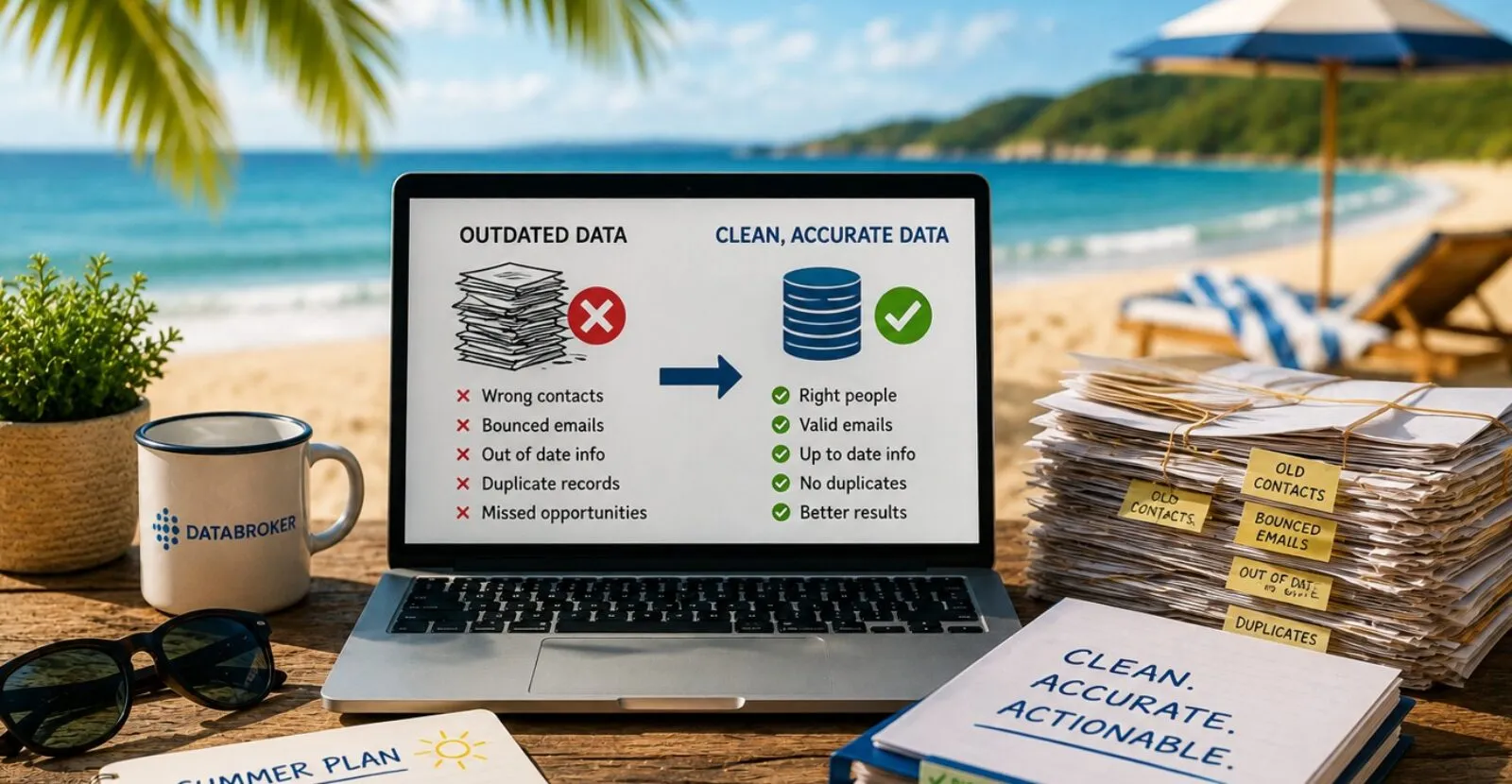
One of the biggest misconceptions about B2B data is that once it’s accurate, it stays accurate. It doesn’t. People move jobs, businesses relocate, companies grow, departments restructure and contact information changes constantly. Nobody has done anything wrong. That’s simply what businesses do. And it’s why B2B data cleansing and regular data refreshes are so important.
In 30 Seconds
- Good B2B data naturally deteriorates as businesses and people change.
- An accurate database today won’t necessarily be accurate in 12 or 24 months.
- Data cleansing isn’t just about removing bounced emails.
- Regular maintenance is generally easier than rebuilding a neglected CRM.
- Your data should evolve alongside the businesses you’re targeting.
Your Data Isn’t Standing Still
I don’t particularly like saying data has “gone out of date”, because it suggests something has gone wrong. In reality, businesses change every day. Someone gets promoted, another person leaves, a company opens a second office, a small business grows to 100 employees, two companies merge or an organisation changes its trading name. All perfectly normal.
But every one of those changes can affect the information sitting inside your CRM. Think about your own business. If somebody had created a detailed database record about you three years ago, would everything still be correct today? The same people, job titles, employee numbers, telephone numbers, locations and company structure? Possibly some of it. Almost certainly not all of it.
Multiply that across thousands of companies and it’s easy to see why maintaining B2B data needs to be an ongoing process.
It’s About More Than Bounced Emails
When people think about old data, email addresses are usually the first thing that comes to mind. An employee leaves, their email stops working and you get a bounce. That’s the obvious stuff.
The less obvious changes can sometimes be more important. A company that had 30 employees when you added it to your CRM might now employ 300. A regional company might have become national. A prospect might have been acquired by a group. The Marketing Manager you originally targeted might now be Marketing Director - or the company may have built an entirely new marketing team around them.
The email address could still work perfectly while the information you’re using to decide who to target, how to segment them and what to say to them is no longer accurate. That’s why good B2B data cleansing should involve much more than simply checking whether an email can still be delivered.
From the Databroker Desk
We’re sometimes asked why business data needs refreshing when it was perfectly accurate when it was originally supplied. The answer is simply that we’re trying to describe something that’s constantly changing.
Businesses recruit, relocate, grow, shrink, merge and close. Decision-makers move around. New companies are formed and new opportunities appear. If the market changes but your database doesn’t, the gap between the two gradually gets bigger.
That’s why we see data cleansing, enhancement and refreshes as part of the same process. You’re not necessarily replacing your database; you’re maintaining an asset you’ve already invested in.
Cleaning Data Is Easier Than Rebuilding It
Broadly speaking, businesses tend to approach their CRM in one of two ways. Some maintain it regularly. They remove duplicates, update decision-makers, validate contact details, enhance missing information and periodically check that companies still fit their target market. Others leave it until there’s a problem.
Usually that’s when bounce rates start climbing, salespeople complain about wrong contacts or nobody can quite explain why a database containing 50,000 records seems to produce very few decent opportunities.
By that point, the job is much bigger. Regular B2B data cleansing isn’t particularly glamorous, but neither is servicing your car. You do it because maintaining something properly is generally easier and cheaper than waiting for it to break.
A Refresh Doesn’t Mean Starting Again
This is worth emphasising because businesses have often invested years building their CRM. Refreshing your data doesn’t mean throwing it away. Quite the opposite.
It could mean retaining all the valuable history and customer intelligence you’ve built while updating the information around it. That might include replacing departed decision-makers, adding missing email addresses or telephone numbers, updating employee and turnover figures, removing duplicate companies or identifying records that no longer fit your target market.
It can also mean adding information that makes the database more useful than it was before. The objective isn’t a shiny new spreadsheet. It’s a better working database.
There’s a Compliance Benefit Too
Data accuracy isn’t only a sales and marketing issue. It’s also an important principle of good data management. Maintaining accurate records makes it easier to understand who you’re contacting, reduces the likelihood of continuing to rely on information you know is wrong and gives everyone using the CRM more confidence in what’s sitting in front of them.
For UK organisations, accuracy is also one of the data protection principles under UK GDPR. That doesn’t mean every piece of B2B data suddenly becomes a compliance problem because somebody changes jobs, but it does reinforce the importance of having sensible processes for reviewing and updating information.
If You Remember One Thing…
Good B2B data isn’t something you sort once and forget about. It’s something you maintain. The businesses that get the most value from their CRM aren’t necessarily the ones constantly buying more data. They’re often the ones that take better care of the information they’ve already got.
Five-Minute Challenge
Think about the database you’re planning to use this autumn and ask yourself when it was last properly reviewed.
Are the decision-makers current? Are company sizes and classifications still accurate? Have duplicates accumulated? Do you know how old some of the prospect records are? Would your sales team confidently pick any record from the CRM tomorrow and start prospecting from it?
If you’re hesitating over those answers, a data cleanse or refresh might be worth doing before the autumn campaign starts.
Looking Ahead
We’ve spent six parts of this series building the foundations: pipeline, CRM, data quality, targeting, decision-makers and maintaining the information underneath it all. Next week, it’s time to put that data to work. We’ll look at how better data supports email, telemarketing, LinkedIn and account-based marketing - and why the strongest B2B campaigns increasingly involve several channels working together rather than one working alone.
Frequently Asked Questions
What is B2B data cleansing?
B2B data cleansing is the process of reviewing business and contact information to identify inaccurate, outdated, duplicated or incomplete records and improve the overall quality of a business database or CRM.
Why does B2B data become outdated?
Businesses constantly change. Employees move jobs, companies relocate, organisations grow or shrink, contact details change and businesses can merge, close or be acquired.
How often should B2B data be cleansed?
There isn’t one rule for every business. The right frequency depends on the size of the database, how actively it’s used and how quickly the target market changes. Regular maintenance is generally more effective than waiting until data quality becomes a problem.
What’s the difference between data cleansing and data enhancement?
Data cleansing generally focuses on correcting, validating or removing inaccurate information. Data enhancement involves adding or updating information to make existing records more complete and useful.
Do I need to replace my existing CRM data?
Not necessarily. Existing CRM data can contain valuable customer history and sales intelligence. Cleansing, refreshing and enhancing it can often improve its usefulness without rebuilding the database from scratch.
Can Databroker cleanse existing B2B data?
Yes. Databroker can help businesses cleanse, validate, enhance and update existing customer and prospect databases, depending on the information available and what the business wants to achieve.